How AI Receptionists Understand Caller Sentiment
When a customer calls a business, what they say is only part of the conversation. Their tone, urgency, choice of words, interruptions, and overall communication style can provide important clues about how they are feeling.
For businesses handling hundreds or thousands of calls, recognizing these signals can be difficult for human teams to do consistently. This is where AI receptionists are becoming increasingly useful.
Modern AI receptionists can listen to conversations, understand caller intent and context, and use conversational signals to determine how a call should be handled. For example, Jaxl’s AI Receptionist is designed to capture caller intent, urgency, and context, route calls based on what the caller needs, and escalate conversations to human teams when required.
What Is Caller Sentiment?
Caller sentiment refers to the emotional tone or attitude a customer communicates during a conversation.
A caller could be:
- Positive – happy with a product or service
- Neutral – looking for information or assistance
- Concerned – worried about an order, payment, or service
- Frustrated – unhappy with an experience
- Urgent – requires immediate attention
Understanding these differences helps businesses respond appropriately instead of treating every call in exactly the same way.
How Do AI Receptionists Detect Sentiment?
AI receptionists analyze multiple elements of a conversation rather than relying on a single keyword.
1. They Analyze the Customer’s Words
The first signal is what the caller actually says.
For example:
“I haven’t received my order yet.”
This may initially sound like a simple delivery question.
However:
“I’ve called three times already and nobody has helped me. Where is my order?”
contains additional context that suggests frustration and a history of unsuccessful interactions.
An AI system can use this context to understand that the second call may require a different response.
2. They Look at Context and Intent
Sentiment becomes much more useful when combined with caller intent.
A customer saying, “I need help with my order,” could simply be asking for an update. However, if the same customer mentions a failed delivery, repeated calls, or an urgent deadline, the conversation becomes more important.
AI receptionists can capture information such as name, intent, urgency, and context while handling the conversation.
This allows the system to determine not just what the customer wants, but also how the situation should be handled.
3. They Pay Attention to Conversational Patterns
Human conversations aren’t always structured.
Customers interrupt, change their questions, repeat themselves, speak quickly, or switch between languages.
Modern voice AI is increasingly designed to handle these conversational patterns, including interruptions, accents, and code-switching. Jaxl, for example, supports conversations across English, Hindi, Hindi-English code-switching, and additional Indian languages.
This makes sentiment and intent analysis more useful in real-world conversations rather than only perfectly structured customer interactions.
What Happens When a Caller Sounds Frustrated?
Recognizing frustration is only useful if the system can do something with that information.
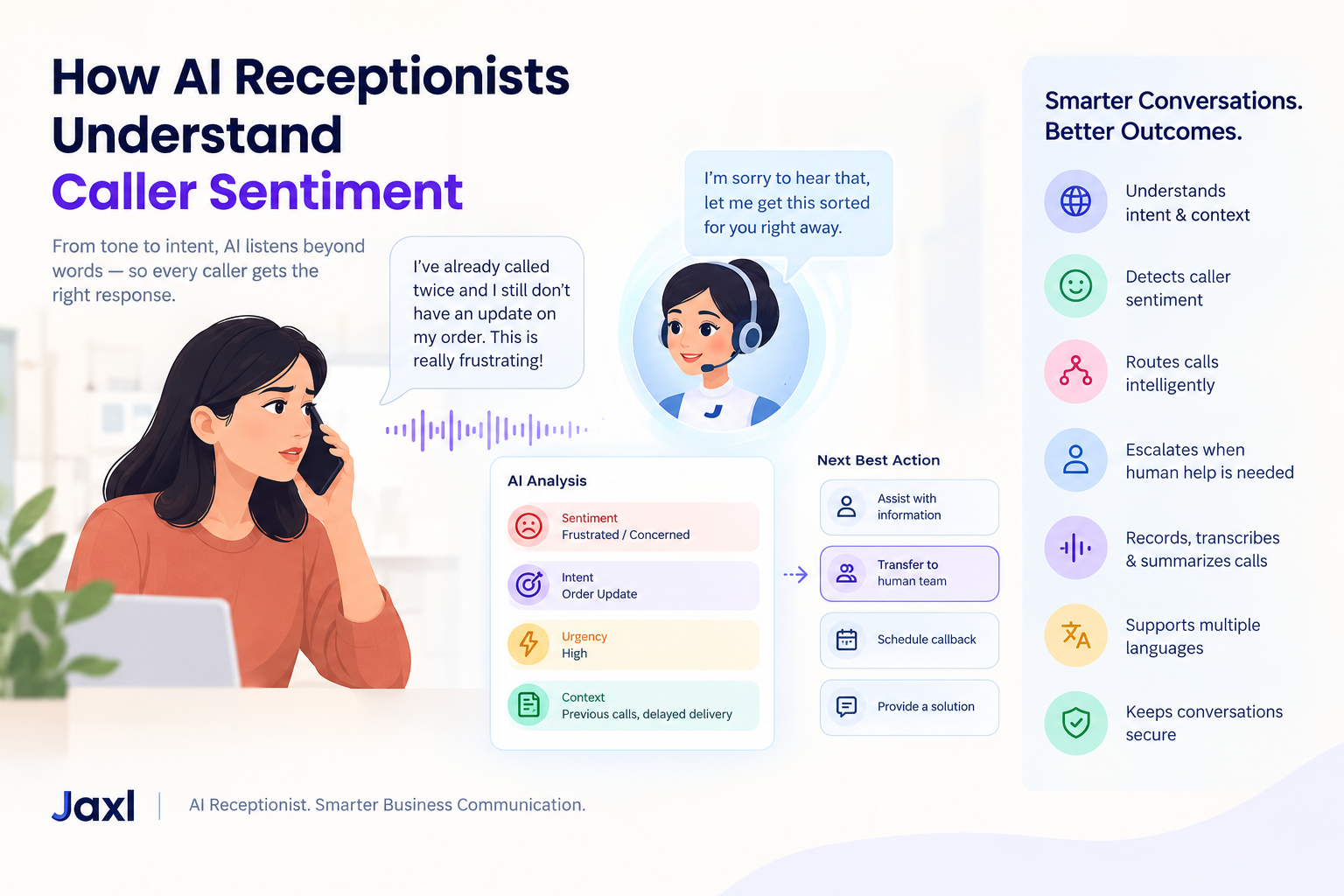
An AI receptionist can use the conversation context to determine whether to:
- Continue helping the customer.
- Collect additional information.
- Provide an answer to a routine question.
- Transfer the caller to the appropriate team.
- Schedule a callback.
- Escalate the conversation when human assistance is required.
For example, imagine a customer calls about a delayed delivery.
The AI receptionist can collect the customer’s information and understand the reason for the call. If the issue requires human intervention, it can route the call to the appropriate team instead of forcing the customer through multiple menus.
Jaxl supports human handoffs, including AI-first or human-first answering, so businesses can decide how much of the conversation should be handled by AI.
Sentiment Analysis Can Improve Customer Experience
One of the biggest advantages of understanding sentiment is better prioritization.
Not every customer issue requires the same level of attention.
For example:
Caller A:
“I’d like to know your business hours.”
Caller B:
“My payment was deducted twice and I need this resolved today.”
Both callers need assistance, but the second situation may require faster escalation.
By combining intent, urgency, and conversational context, an AI receptionist can help businesses distinguish between routine requests and conversations that may need immediate human attention.
AI Receptionists Don’t Have to Replace Human Teams
A common misconception is that using an AI receptionist means removing humans from customer conversations.
In reality, AI can work as the first layer of support, while human employees handle conversations that require empathy, judgment, negotiation, or specialized knowledge.
For example:
AI receptionist → Understands the request → Identifies urgency → Collects details → Routes to the right person
This creates a hybrid approach where AI handles repetitive interactions while employees focus on more complex conversations.
Jaxl supports live AI-to-human handoffs, allowing a human team member to take over the same conversation when necessary.
Every Conversation Can Become Useful Data
Another important advantage is what happens after the call.
Instead of relying entirely on an employee’s memory or manual notes, AI-powered phone systems can record and organize information from conversations.
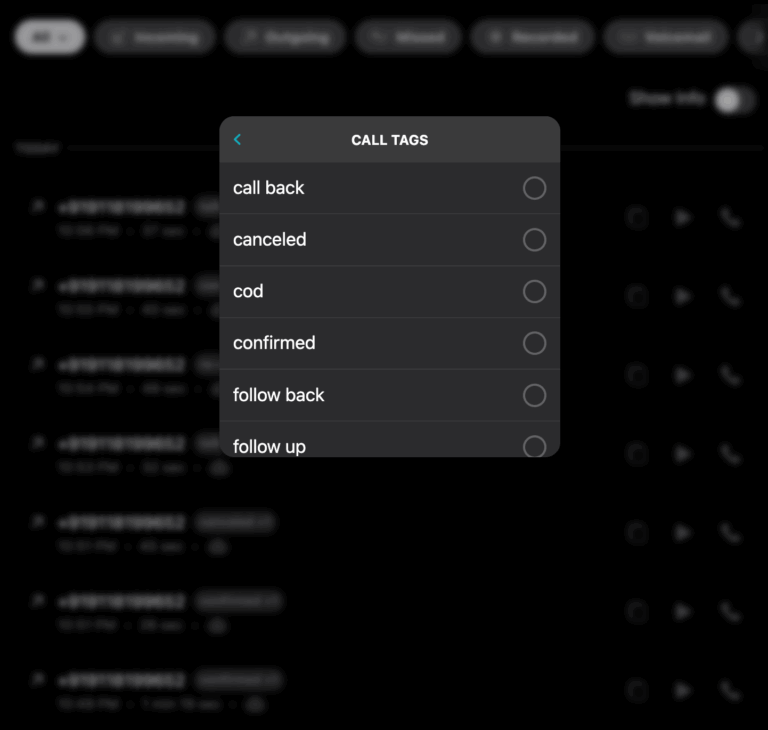
Jaxl’s AI Receptionist provides recordings, transcripts, AI summaries, and automatic tags for calls, helping teams review conversations and understand outcomes more efficiently.
This can help businesses identify patterns such as:
- Repeated customer complaints
- Frequently requested products or services
- Common delivery problems
- Sales objections
- Support issues
- High-priority customer conversations
- Recurring reasons for calling
Over time, these insights can help businesses improve their products, processes, and customer experience.
A Simple Example
Consider an online retailer receiving this call:
Customer:
“My order was supposed to arrive yesterday. I’ve already contacted support, and I still don’t have an update.”
An AI receptionist can recognize several signals:
Intent: Delivery issue
Context: Order is delayed
Urgency: Customer wants an immediate update
Sentiment: Frustration or concern
Instead of simply responding with a generic message, the system can collect the required information, check the appropriate workflow, and either assist the customer or route the conversation to a human team member.
The result is a more contextual customer experience.
AI Receptionist vs. Traditional IVR
Traditional IVR systems generally depend on predefined menus:
“Press 1 for Sales.”
“Press 2 for Support.”
“Press 3 for Billing.”
An AI receptionist can have a more natural conversation.
A caller might simply say:
“I’m calling because my order hasn’t arrived and I need help.”
The AI can understand the request and route the call based on the caller’s actual need rather than forcing them to navigate several menu options.
Jaxl describes its AI Receptionist as a system that can converse, decide, route, and report, while also taking real messages and handing calls to humans when needed.
Why Caller Sentiment Matters for Businesses
Understanding sentiment can help businesses move from simply answering calls to understanding the conversations happening on those calls.
It can help teams:
- Prioritize urgent conversations
- Improve customer support
- Reduce unnecessary transfers
- Identify recurring customer problems
- Escalate complex issues faster
- Give human agents better context
- Analyze customer conversations at scale
Most importantly, it helps businesses recognize that every customer interaction has context.
Final Thoughts
AI receptionists are evolving beyond automated call answering. They can listen to conversations, understand intent and urgency, capture context, and help businesses determine the next appropriate action.
However, sentiment should not be treated as a perfect measurement of a person’s emotions. It works best as one signal among several, combined with what the customer says, why they are calling, their history, and the actions required.
For businesses, the goal isn’t simply to have an AI that answers every call. The goal is to have an AI receptionist that understands the conversation well enough to know what should happen next.
With capabilities such as 24/7 answering, contextual routing, human handoffs, recordings, transcripts, summaries, and automatic call tagging, Jaxl Business Phone is designed to help businesses manage customer conversations more intelligently.