How AI Receptionists Handle Wrong Numbers
Not every incoming call is from a customer.
Businesses regularly receive calls from people who have dialed the wrong number, are looking for another department, have mistaken a business number for a personal one, or simply need help reaching the right organization. Traditionally, these calls can interrupt employees, consume support time, or end abruptly without any useful information being captured.
An AI receptionist can handle these situations more intelligently.
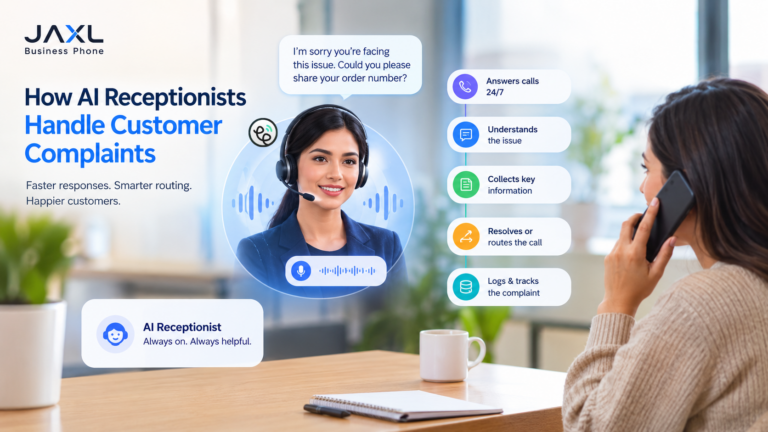
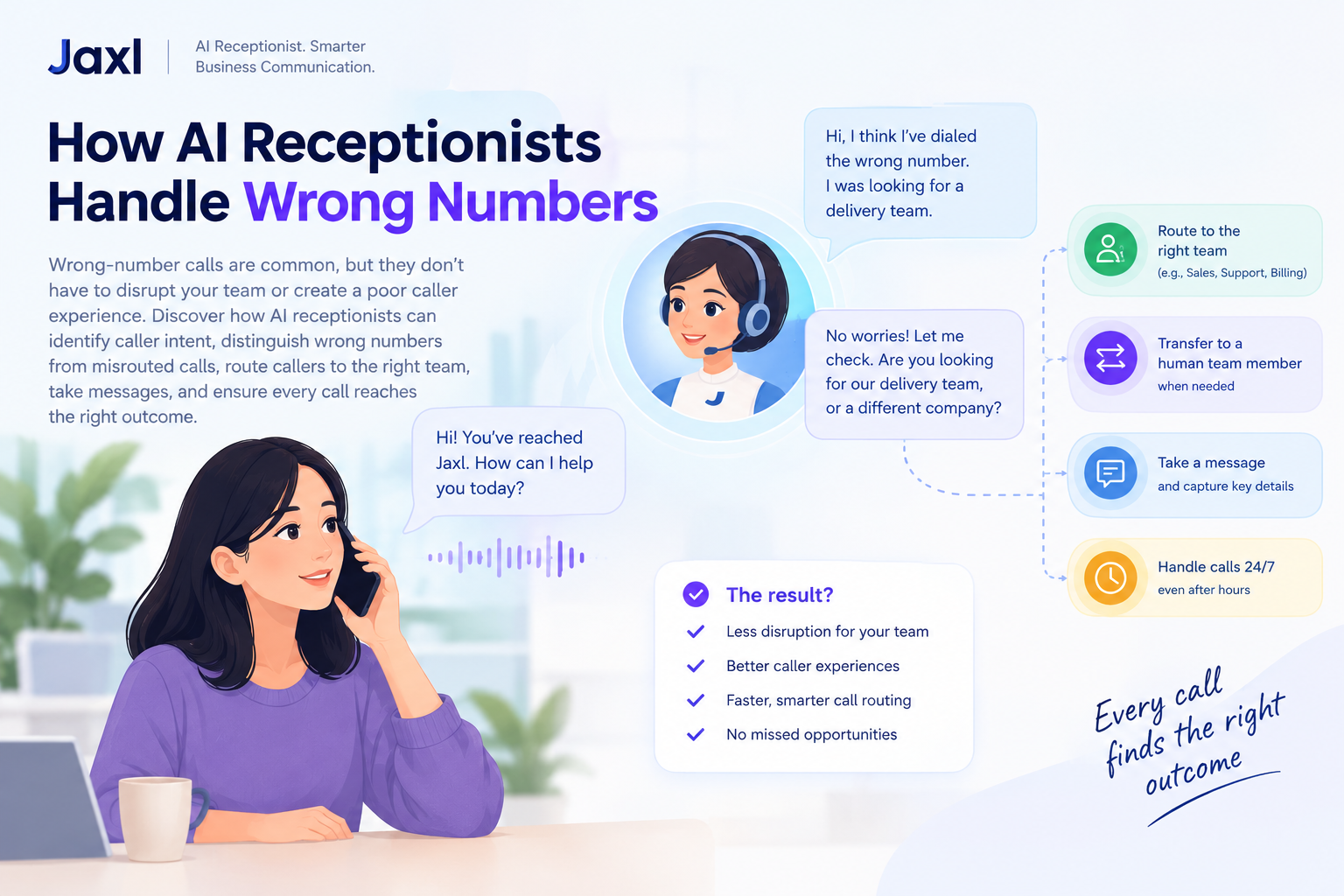
Instead of simply answering with a recorded message, an AI receptionist can have a natural conversation, understand why the caller is calling, and determine whether the call should be redirected, transferred, or ended politely. Jaxl’s AI Receptionist is designed to answer calls 24/7, understand caller intent and context, route calls based on what the caller needs, and hand calls to human team members when necessary.
What Is a Wrong-Number Call?
A wrong-number call happens when someone reaches a business number but is not actually trying to contact that business or department.
For example:
“Hi, is this the delivery team?”
The caller may have intended to contact a different company or may have simply selected the wrong number.
Other examples include:
- A customer calling the wrong department
- Someone looking for a specific employee
- A caller dialing an old business number
- A customer confusing two similar phone numbers
- Someone trying to reach a different company
- A caller who doesn’t know which department they need
While these calls may appear insignificant, handling them properly can still affect the overall customer experience.
How AI Receptionists Handle Wrong Numbers
1. They Answer the Call Instead of Sending It to Voicemail
The first step is simple: answer the call.
A business may receive calls outside working hours, during holidays, or when employees are already busy. Jaxl’s AI Receptionist can answer incoming calls 24/7, so callers aren’t automatically pushed to voicemail simply because the team isn’t available.
For a wrong-number call, this means the caller can quickly clarify their reason for calling rather than repeatedly dialing different numbers.
2. They Ask What the Caller Needs
A traditional phone system might immediately ask the caller to:
“Press 1 for Sales.”
“Press 2 for Support.”
“Press 3 for Billing.”
An AI receptionist can instead start with a conversational question:
“Hi, how can I help you today?”
The caller can then explain their situation naturally.
For example:
Caller: “I’m trying to reach someone about a delivery.”
AI: “Sure. Are you calling about an existing order or a new delivery enquiry?”
This helps the AI understand the intent and context behind the call rather than relying only on keypad selections.
Jaxl specifically describes its AI Receptionist as capturing the caller’s name, intent, urgency, and context while handling conversations.
3. They Determine Whether It’s Actually a Wrong Number
Not every unusual call is necessarily a wrong number.
For example, someone may say:
“I think I have the wrong number, but I’m actually trying to contact your sales team.”
Instead of immediately ending the call, an AI receptionist can ask a clarifying question.
This distinction is important because a caller who thinks they’ve dialed the wrong number could actually be a potential customer.
The AI can determine whether the caller:
- Reached the wrong company
- Reached the wrong department
- Needs another team
- Has a genuine business enquiry
- Needs a human representative
- Simply wants to end the call
This makes the interaction more useful than an automated “wrong number” response.
4. They Can Route Calls to the Right Team
Sometimes the caller has reached the correct business but the wrong person or department.
For example:
“I was trying to speak with someone about my invoice.”
Rather than telling the caller to find another number, an AI receptionist can understand the request and route the conversation appropriately.
Jaxl supports call routing based on what the caller actually needs, as well as IVR flows and human handoffs.
This can be especially useful for businesses with separate:
- Sales teams
- Customer support teams
- Billing departments
- Operations teams
- Delivery teams
- HR teams
5. They Can Transfer the Caller to a Human
Some situations are better handled by a person.
For example:
“I’m not sure who I need to speak with, but this is regarding a serious issue with my account.”
An AI receptionist can collect the initial information and transfer the caller to the appropriate human team member when required.
Jaxl supports both AI-first and human-first answering, allowing businesses to decide how they want calls to be handled. Its AI can also hand off an ongoing conversation to a human without requiring the caller to start over.
This creates a smoother experience for the caller.
6. They Can Take a Message When Nobody Is Available
Sometimes the caller isn’t actually dialing the wrong number they simply don’t know who they need to contact.
Instead of ending the conversation, the AI receptionist can collect useful information.
For example:
“I’m trying to reach someone regarding an existing order. Please have someone call me back.”
An AI receptionist can capture:
- Caller details
- Reason for calling
- Contact information
- Relevant context
- Callback requirements
Jaxl’s AI Receptionist can take real messages and log information about who called, why they called, and how to reach them.
This means even an unexpected call can become a useful follow-up opportunity.
Wrong Number vs. Wrong Department
It’s important for businesses to distinguish between these two situations.
Wrong Number
The caller has contacted the wrong business entirely.
Example:
“I’m looking for a restaurant called ABC Foods.”
The AI can politely clarify that they’ve reached the wrong number and end the call.
Wrong Department
The caller has reached the correct business but needs another team.
Example:
“I’m already a customer, but I need help with my invoice.”
In this situation, the AI can identify the requirement and route the caller to billing or the appropriate team.
This distinction is one reason conversational AI can be more flexible than traditional phone menus.
AI Receptionists Can Also Identify Potential Customers
A wrong-number call isn’t always a useless call.
Consider this conversation:
Caller: “Sorry, I was looking for another company, but since I’ve reached you, do you provide logistics services?”
At this point, the conversation has changed.
The caller may have discovered your business accidentally but could still be a potential customer.
An AI receptionist can answer questions about the business based on the information provided to it and, when appropriate, route the conversation to sales.
Jaxl’s platform supports AI agents that can qualify leads, answer business questions, and hand calls to the appropriate team.
Every Call Can Be Logged
Another advantage of an AI receptionist is what happens after the conversation.
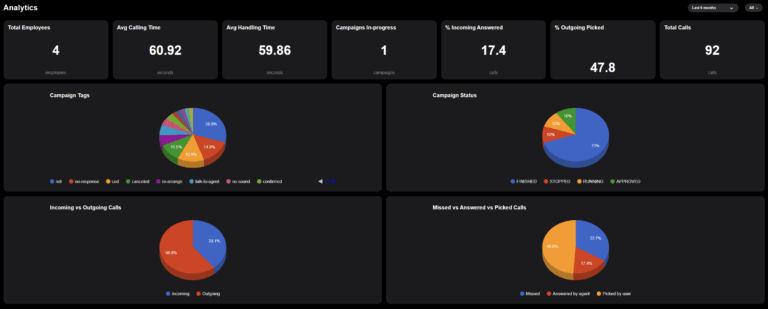
Instead of leaving employees to manually remember or document every unexpected call, Jaxl can provide call recordings, transcripts, AI summaries, and automatic tags in the same dashboard.
This gives businesses a record of:
- Why the caller contacted them
- Whether it was a genuine wrong number
- Whether the caller needed another department
- Whether a callback was requested
- Whether the call was transferred
- What the final outcome was
Over time, this information can reveal patterns.
For example, if a company repeatedly receives calls intended for another department, it may indicate that its phone numbers or website information need to be updated.
Why Handling Wrong Numbers Matters
Wrong-number calls may seem insignificant, but poor handling can create unnecessary friction.
A caller who hears:
“You’ve reached the wrong number.”
may simply hang up.
A conversational AI receptionist can instead say:
“I may be able to help. Could you tell me who you’re trying to reach?”
That small difference can create a much better experience.
For businesses, the benefits include:
- Fewer interruptions for employees
- Better call routing
- Faster identification of caller intent
- Fewer unnecessary transfers
- Better after-hours coverage
- More consistent customer experiences
- Better visibility into incoming calls
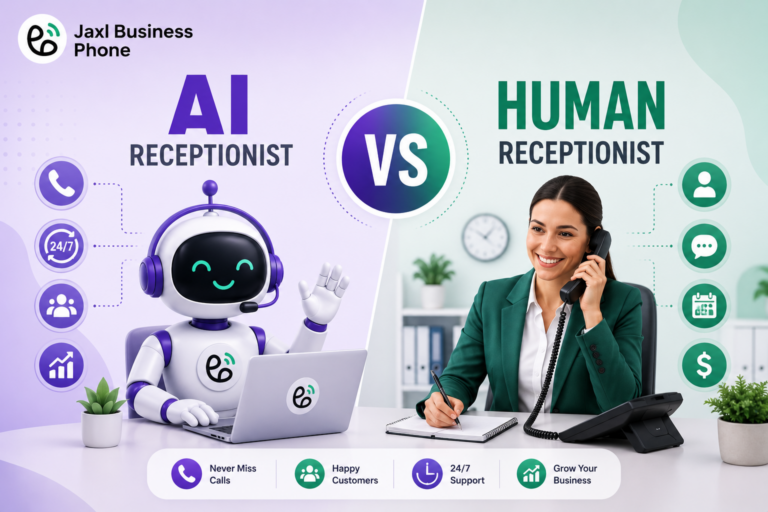
AI Receptionist vs. Traditional Phone Systems
| Traditional Phone System | AI Receptionist |
|---|---|
| Fixed menu options | Natural conversation |
| Caller chooses predefined options | Caller explains what they need |
| Limited understanding of context | Understands intent and context |
| Often sends after-hours calls to voicemail | Can answer 24/7 |
| Manual message-taking | Can capture and log messages |
| Basic routing | Context-based routing |
| Limited call information | Recordings, transcripts and summaries |
Jaxl combines AI reception with traditional business-phone capabilities such as IVR, multi-agent ringing, call recording, analytics, and human handoffs.
Best Practices for Handling Wrong Numbers with AI
To make wrong-number handling effective, businesses should:
Keep the greeting simple
Don’t overwhelm callers with a long introduction.
Ask an open-ended question
“How can I help you?” gives the caller freedom to explain their situation.
Avoid ending calls too quickly
A caller who appears to have dialed the wrong number may still have a genuine business enquiry.
Provide a human handoff
Complex or unclear situations should have an escalation path.
Capture useful information
If a callback or follow-up is required, collect the relevant details.
Review call patterns
Frequent wrong-number calls can indicate outdated contact information or confusing phone routing.
Final Thoughts
Wrong-number calls are unavoidable for most businesses. The real question is how those calls are handled.
An AI receptionist can turn an unexpected call into a structured conversation by answering immediately, understanding what the caller needs, distinguishing between a genuine wrong number and a misrouted business call, routing the conversation when appropriate, and handing it to a human when necessary.
With Jaxl, businesses can combine 24/7 AI answering, intelligent call routing, human handoffs, message capture, recordings, transcripts, summaries, and automatic call tagging to create a more complete approach to inbound communication.
The goal isn’t to make every call longer. It’s to make sure every call reaches the right outcome.