Multilingual AI Receptionist: Make Every Business Call Easier
Customers do not all communicate in the same way.
They may speak different languages, use different accents, or switch between languages during a conversation. For businesses serving diverse customers, handling every call in a familiar language can be challenging.
A multilingual AI receptionist can help.
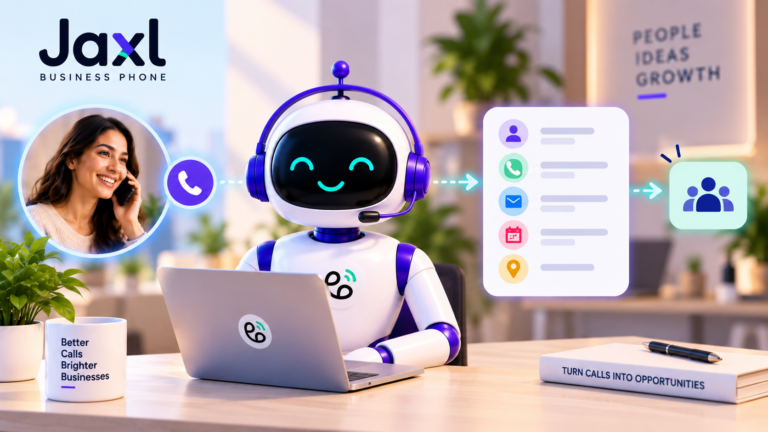
It can answer incoming calls, understand customer requests, provide information, route calls, and hand conversations to a human team member when needed.
The result is a simpler phone experience for both customers and businesses.
What Is a Multilingual AI Receptionist?
A multilingual AI receptionist is an AI-powered phone agent that can communicate with callers in multiple languages.
Unlike a traditional IVR, callers do not always have to navigate a long list of numbered options.
Instead, they can explain what they need in a natural conversation.
For example:
“Hi, I want to know your store timings.”
The AI receptionist can understand the request and provide the relevant information.
If the caller needs sales support, the AI can route the call to the appropriate team.
If the request needs personal attention, it can hand the conversation over to a human.
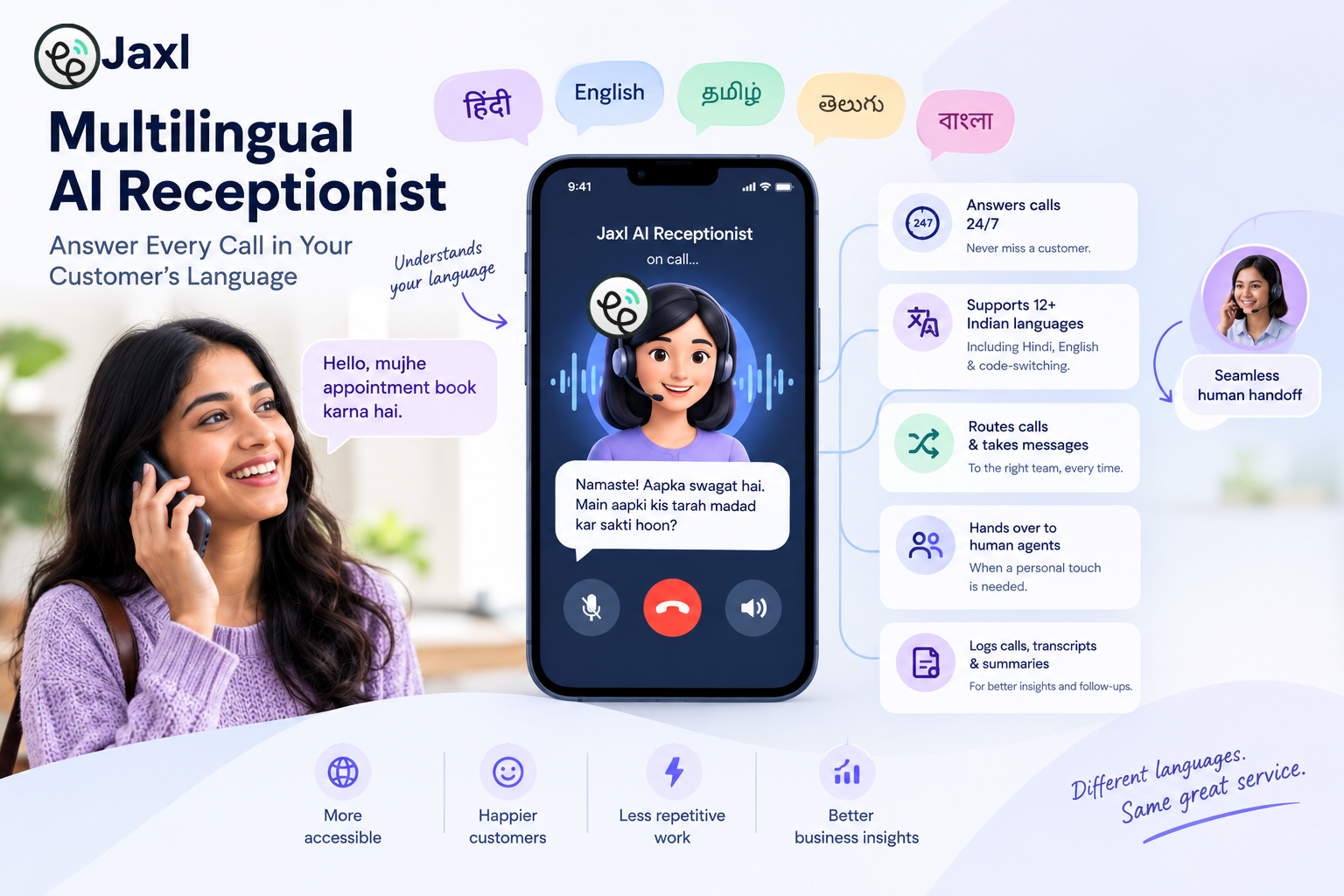
Jaxl’s AI receptionist is designed to answer calls 24/7, understand callers in their language, route conversations, take messages, and support human handoffs.
Why Does Multilingual Calling Matter?
Language can influence how comfortable customers feel during a conversation.
A customer may understand English but prefer Hindi when discussing a detailed question. Another customer may naturally switch between both languages.
This is common in multilingual markets.
When businesses make it easier for customers to communicate, conversations can become more accessible and comfortable.
A multilingual AI receptionist can support this by handling conversations across different languages and communication styles.
How Does a Multilingual AI Receptionist Work?
The process is straightforward.
1. A customer calls your business
The AI receptionist answers the call instead of sending the customer to voicemail.
Jaxl’s AI receptionist is designed to answer calls 24/7, including outside regular business hours.
2. The AI understands the request
The caller can explain why they are calling.
For example:
- “I want to book an appointment.”
- “Can you tell me your working hours?”
- “Mujhe apne order ke baare mein poochna hai.”
- “Can you connect me with sales?”
The receptionist identifies the caller’s intent and continues the conversation.
3. The conversation can happen in the customer’s language
Jaxl describes support for Hindi, English, Hindi-English code-switching, and 12+ Indian languages.
This can be useful for businesses that serve customers across different regions.
4. The AI takes action
Depending on the workflow, the receptionist can:
- Answer common questions
- Route calls
- Take messages
- Schedule callbacks
- Transfer callers to team members
- Follow predefined business processes
5. The call is logged
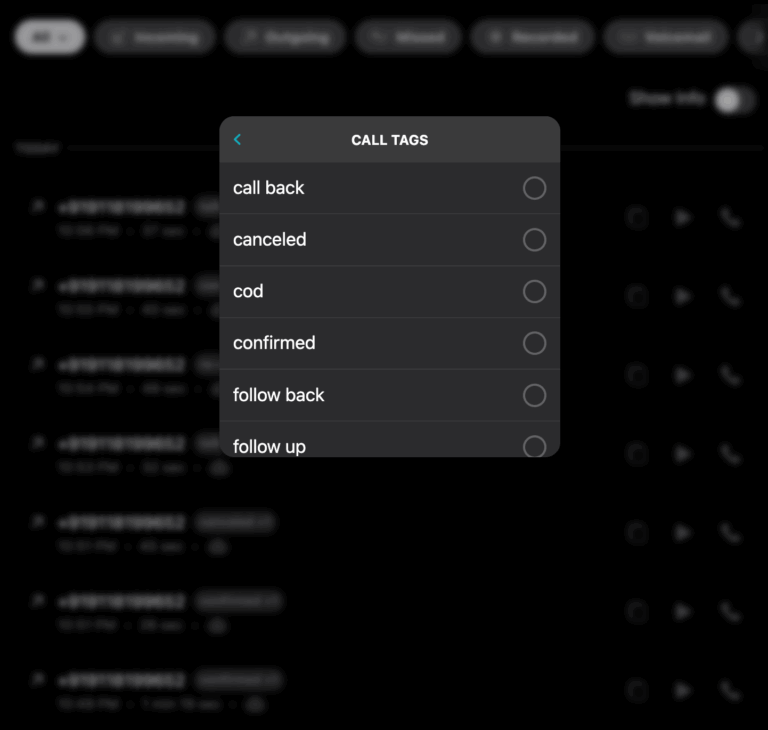
Jaxl states that calls can include recordings, transcripts, AI summaries, and automatic tags.
This gives teams a record of what happened during the conversation.
Multilingual AI vs. Traditional IVR
Traditional IVRs can be useful for structured call routing.
However, they often require callers to listen to several options before reaching the right department.
A conversational AI receptionist offers another approach.
| Traditional IVR | Multilingual AI Receptionist |
|---|---|
| Caller selects numbered options | Caller explains what they need |
| Usually follows a fixed menu | Can handle conversational requests |
| Language options may be limited | Can support multiple languages |
| Often routes through menus | Can identify intent and route accordingly |
| May send callers to voicemail | Can answer calls 24/7 |
The right choice depends on the business and its call workflows. In many cases, AI and IVR can also work together.
Handle Hindi, English, and Code-Switching
People do not always speak one language from beginning to end.
A conversation might sound like:
Customer: “Hello, mujhe appointment book karna hai for tomorrow.”
AI: “Sure. What time would you prefer?”
Customer: “Around 11 AM would be fine.”
This type of code-switching is common in everyday conversations.
Jaxl specifically describes its multilingual voice capability as supporting Hindi-English code-switching along with Hindi, English, and 12+ Indian languages.
Keep Your Business Available 24/7
Customer questions do not always arrive during office hours.
A customer may call:
- Early in the morning
- During lunch hours
- Late at night
- On weekends
- During holidays
A multilingual AI receptionist can answer these calls even when the human team is unavailable.
Jaxl describes its receptionist as a 24/7 system that can answer calls when teams are busy, offline, or outside normal business hours.
This gives customers another way to get help without waiting for the next business day.
Route Calls to the Right Team
Not every caller needs the same type of support.
One customer may want to speak with sales.
Another may have a support question.
Someone else may want to leave a message.
A multilingual AI receptionist can identify the reason for the call and route it accordingly.
For example:
Customer: “I want to know the price of your service.”
AI: “Sure. I’ll connect you with our sales team.”
This can reduce unnecessary transfers and help teams focus on the conversations relevant to them.
Keep Humans in the Conversation
AI does not need to handle every conversation alone.
Some requests need human support.
For example:
- A complex customer complaint
- A billing concern
- A detailed sales discussion
- A sensitive service issue
- A request outside the AI’s workflow
In these cases, the AI receptionist can hand the call to a human team member.
Jaxl supports both human-first and AI-first answering approaches, with escalation when a human is needed.
This creates a simple model:
AI handles routine calls.
People handle conversations that need personal attention.
Who Can Use a Multilingual AI Receptionist?
A multilingual receptionist can be useful for many types of businesses.
Ecommerce
Answer order-related questions and route customer calls.
Healthcare
Help callers with basic information and direct them to the appropriate team.
Education
Handle student and parent enquiries across different languages.
Real Estate
Respond to property enquiries and route interested leads to sales teams.
Hospitality
Answer booking-related questions and provide basic information.
Salons and Spas
Handle appointment enquiries and callback requests.
Travel Businesses
Answer common questions and route booking enquiries.
Jaxl lists industries including ecommerce, healthcare, education, real estate, hospitality, salons and spas, logistics, travel, and more.
Benefits of a Multilingual AI Receptionist
A multilingual AI receptionist can help businesses:
- Answer more calls
- Provide support outside business hours
- Communicate in multiple languages
- Reduce repetitive phone work
- Route calls based on customer intent
- Capture messages and caller details
- Keep call records
- Give human teams more time for complex conversations
These benefits are especially useful for businesses that receive a high volume of inbound calls.
Make Customer Communication More Inclusive
Good customer communication should be easy to access.
That means considering differences in language, communication preferences, and customer needs.
A multilingual AI receptionist can support this by giving customers more ways to communicate comfortably.
However, language support should not be treated as a replacement for human assistance.
Customers should still have access to a person when their situation requires it.
What Should You Look For in a Multilingual AI Receptionist?
Before choosing a solution, consider these features:
Multiple language support
Check whether the languages your customers use are supported.
Natural conversations
The AI should allow customers to speak naturally rather than forcing them through rigid menus.
Code-switching
Look for support for customers who move between languages during a conversation.
24/7 availability
Consider whether the receptionist can answer calls outside your team’s working hours.
Human handoff
Customers should be able to reach a human when necessary.
Call records
Recordings, transcripts, summaries, and tags can help teams review conversations.
Flexible call routing
The system should be able to direct calls to the right team or workflow.
The Future of Business Phone Support
Business phone systems are moving beyond basic calling and fixed IVR menus.
AI can now help businesses answer, understand, route, and document customer conversations.
Multilingual support adds another layer to this experience.
Instead of asking every customer to adapt to one language, businesses can create phone experiences that better reflect the way their customers actually communicate.
Final Thoughts
A multilingual AI receptionist can help businesses make their phone support more accessible, responsive, and consistent.
It can answer calls 24/7, communicate across multiple languages, understand customer intent, route conversations, and hand calls to human team members when needed.
Jaxl’s AI receptionist supports multilingual conversations, including Hindi, English, Hindi-English code-switching, and 12+ Indian languages, alongside call routing, message taking, human handoffs, and call logging.
For businesses serving diverse customer groups, multilingual AI can be a practical way to make every call easier to handle.
Want to make your business phone multilingual?
Explore Jaxl Business Phone and see how an AI receptionist can help your team answer and manage calls around the clock.